
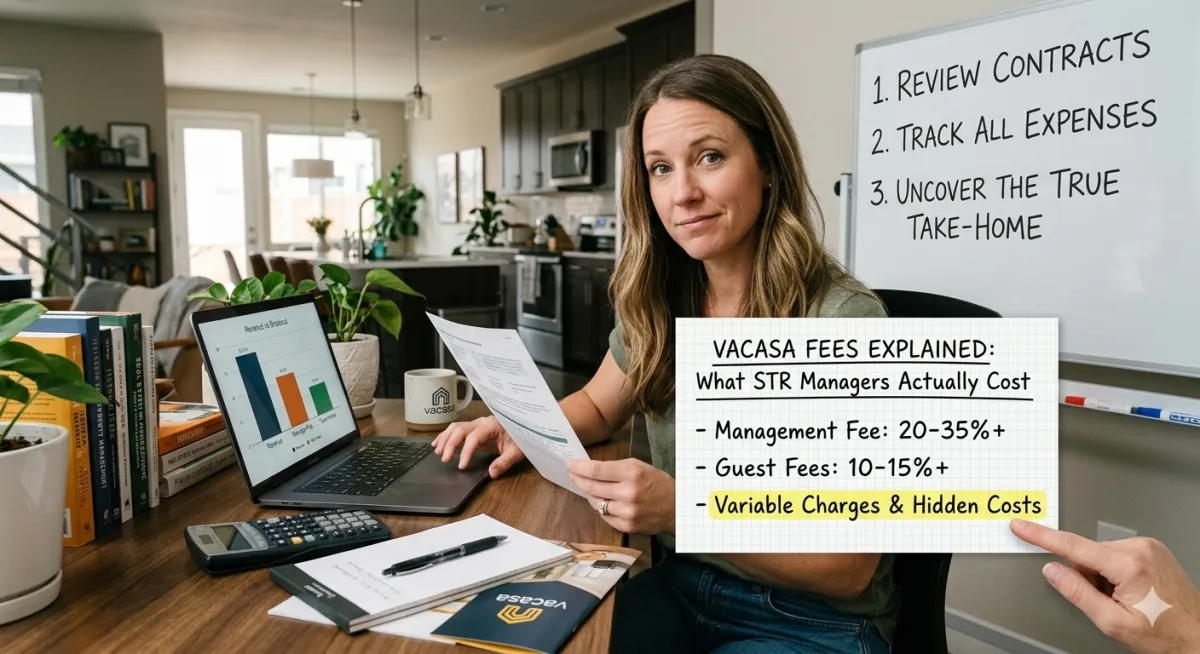
Vacasa Fees Explained: What STR Managers Actually Cost The Real Cost of Vacasa-Style STR Management: A 2026 Fee Breakdown for Property Owners
Overview
Large national STR property managers like Vacasa typically charge 25 to 35 percent of gross revenue, with additional markups on cleaning, maintenance, and supplies. A boutique manager operating on a flat 15 percent accommodation-only fee structure can save the average owner $6,000 to $12,000 annually on a single $80,000 property with more direct owner communication and tighter property-level attention. Understanding what the fee number actually represents, and what it is calculated against, is the most important financial analysis an STR owner can do before signing any management agreement.
Zenstays charges 15 percent of accommodation revenue across San Diego, Louisville, and Indianapolis. Schedule a free call to see the exact math on your property.
Why National STR Brands Charge Higher Fees
Inventory volume vs personalized service
National STR brands operate at scale because scale justifies their overhead: centralized call centers, standardized pricing tools, national vendor contracts, and marketing infrastructure. That scale has value in some categories and real costs in others. The cost that owners absorb is that their property is one of tens of thousands of doors a volume that makes personalized management economically impossible at the unit level.
The "account number" effect at scale
The defining complaint among owners who leave Vacasa and similar national brands is not fee size it is the experience of being treated like an account number rather than a client. Maintenance requests go through ticketing systems. Rate changes are algorithmic, not strategic. Owner communication is reactive. The irony is that the higher gross fee often funds a more impersonal service experience, not a better one.
Layered fees you might not see in the headline rate
National brands often separate their base management fee from a secondary layer of additional charges: cleaning coordination fees, maintenance project markups, supply procurement markups, and platform fee pass-throughs. A 25 percent headline rate with these secondary charges active can produce an effective total cost to the owner of 30 to 40 percent of what the property earns. Always request a complete schedule of fees not just the management percentage.
The Real Numbers on an $80,000 STR Property
Vacasa-style 30 percent gross fee scenario
On a property generating $80,000 in gross revenue ($65,000 accommodation, $12,000 cleaning, $3,000 add-ons): a 30 percent gross fee produces a management cost of $24,000 per year. Before you factor in maintenance expenses, platform fees, insurance, or mortgage -- the management fee alone is $24,000. That is 30 percent of everything the property earns, including money that never profits the owner.
20 percent gross plus cleaning markup scenario
A mid-tier manager charging 20 percent gross with a cleaning coordination markup produces a different number: 20 percent of $80,000 is $16,000, plus an average 10 to 15 percent markup on $12,000 in cleaning costs adds $1,200 to $1,800. Total management cost: $17,200 to $17,800 per year. Still meaningfully higher than an accommodation-only alternative, and with a secondary fee that is difficult to audit without detailed cleaning invoices.
15 percent accommodation-only scenario
At 15 percent of accommodation revenue only: 15 percent of $65,000 is $9,750. No cleaning fee haircut. No markup on supplies. The gap versus the Vacasa-style scenario is $14,250 per year on the same property. On two properties at the same earnings profile, that is $28,500 annually that stays with you instead of your manager.
Ready to run your current fee structure against Zenstays' model? Schedule a free call and Zenstays will get back to you fast.
What to Demand From Any STR Manager Before Signing
Fee base clarity (gross, net, or accommodation-only)
The contract must specify what the percentage is calculated against. "Total revenue," "gross receipts," or "all monies collected" means cleaning fees and add-ons are in the base. Only "accommodation revenue" or "nightly rental income" protects the owner from paying management fees on cost-recovery line items. If the contract language is ambiguous, request a written amendment that defines the fee base explicitly.
Cleaning and supply pass-through policy
Ask directly: does the manager mark up cleaning costs above what the cleaning crew charges? Do they mark up supplies? A manager who is transparent about pass-through policy will answer this immediately. One who hedges or deflects has a financial interest in obscuring the answer. Cleaning and supply transparency is a basic minimum for any management relationship.
Owner portal and reporting cadence
You should have access to a real-time owner portal showing bookings, revenue, and expenses. Monthly statements should be itemized line by line. Any manager who cannot provide this within the first month of operations is telling you that the reporting infrastructure does not exist and without it, you cannot verify anything.
Contract length and exit terms
National brands often require 12-month contracts with 60 to 90 day notice requirements and retain fees on pre-existing bookings through the end of the notice period. A boutique manager confident in their performance will offer shorter initial terms or month-to-month options after the first 90 days. Review exit terms carefully they tell you how confident the manager is that you will want to stay.
Frequently Asked Questions
Is Vacasa worth the higher fee?
For some owners in some situations, the national brand infrastructure provides value particularly for properties in markets where local boutique options are limited. But in markets like San Diego, Louisville, and Indianapolis where qualified boutique managers exist, the fee premium for a national brand typically funds centralization and overhead rather than better outcomes for the individual property. The answer depends entirely on what you are paying for versus what you are getting.
What is a fair Airbnb management fee in 2026?
A fair full-service management fee in 2026 is 15 to 20 percent of accommodation-only revenue. Any fee calculated on gross revenue which includes cleaning fees and add-ons -- should be evaluated on an accommodation-equivalent basis before comparison. A 15 percent gross fee and a 15 percent accommodation-only fee are not the same number, and treating them as equivalent is the most common mistake owners make when comparing management contracts.
Are boutique STR managers actually better than national brands?
In markets where the boutique manager has genuine local expertise, the answer is typically yes for investor owners. A boutique manager with direct owner access, a transparent fee structure, local compliance knowledge, and a smaller portfolio of doors consistently outperforms national brands on the metrics that matter most to owners: ADR, occupancy rate, review score maintenance, and owner communication. The trade-off is the national brand's marketing scale, which matters less in markets with strong organic Airbnb demand.
How do I compare two STR management contracts side-by-side?
Convert all fees to a common basis: what is the total annual cost to the owner as a percentage of accommodation revenue only? List every fee base management, cleaning coordination, supply markup, maintenance markup, platform fees and calculate them against the same sample revenue profile. Most owners who run this comparison on a real property find the gap between a gross-fee national brand and an accommodation-only boutique manager is $6,000 to $15,000 per year on a single property.
Zenstays charges 15 percent of accommodation revenue not gross with no cleaning markup, no supply markup, and full monthly P&L transparency. Schedule a free call to see what that looks like on your specific property.
