
Best STR Markets 2026: San Diego, Louisville, Indianapolis
The 3 Best STR Markets Right Now
Overview
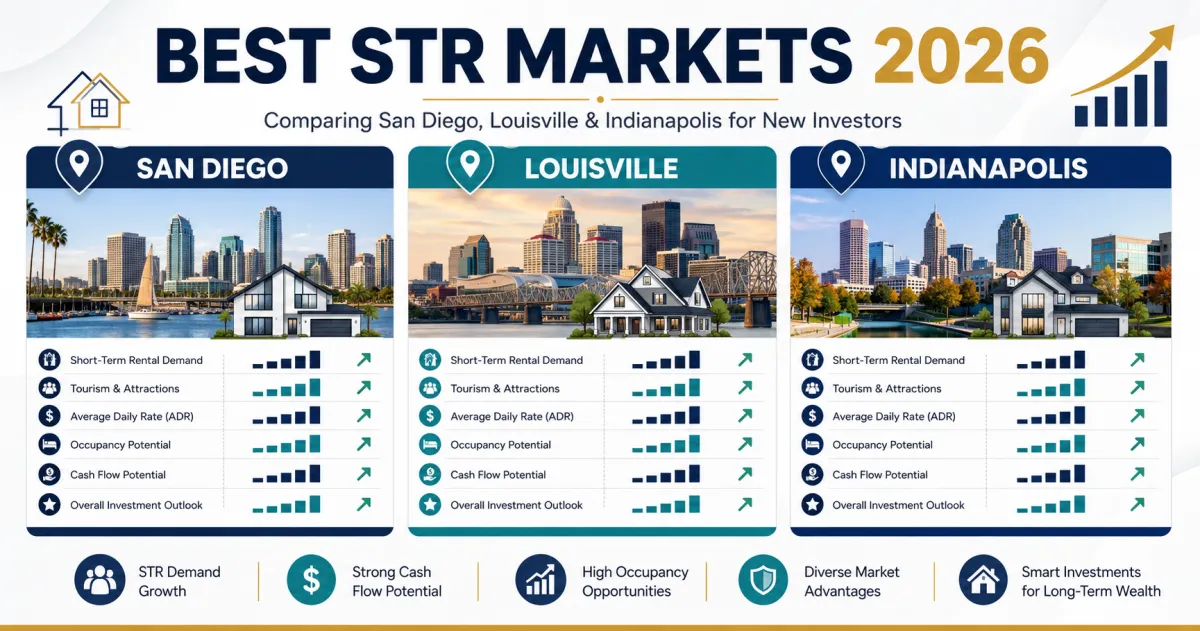
Among the best STR markets to invest in right now, San Diego, Louisville, and Indianapolis represent three distinct investment profiles, and the right one depends entirely on your capital, your regulatory tolerance, and the return you are targeting. San Diego delivers premium year-round ADR on a tier-licensed coastal market where scarcity protects pricing. Louisville runs on event-driven RevPAR spikes anchored by the Kentucky Derby and a steady bourbon-tourism calendar. Indianapolis moves on convention and sports traffic with the lowest entry cost and the lightest regulatory risk of the three. There is no single best market, only the best fit for what you have and what you want out of the investment.
Deciding between markets? Zenstays operates in all three. Get a free market consultation at myzenstays.com and we will help you compare the numbers.
How to Compare STR Markets Like an Investor
ADR vs total revenue vs IRR
A high nightly rate is not the same as a high return, and confusing the two is how investors overpay for prestige markets. Average Daily Rate tells you what a night earns, total revenue tells you what the year earns after occupancy, and internal rate of return tells you what your capital earns after the property's cost is factored in. A coastal property with a premium ADR can deliver a lower return than a modest inland one if the purchase price is high enough. Compare markets on the metric that actually matters to your goal, which for most investors is return on the money deployed, not the headline rate.
Regulatory risk as a market filter
Regulation is not a footnote in STR investing, it is a market filter that can eliminate a property overnight. A market with tightening rules, license caps, or aggressive enforcement carries a different risk profile than one with a stable framework, even if the revenue looks similar. Smart investors treat regulatory exposure as a first-pass screen, because the best pro forma in the world is worthless if the city stops issuing the permit the property depends on.
Demand stability vs seasonality
Some markets earn steadily across the calendar and some earn in concentrated bursts. Neither is inherently better, but they demand different operating strategies and different cash reserves. A steady market forgives a slow month. A seasonal market requires you to capture the peak because the peak is the year. Understanding where a market sits on that spectrum tells you how aggressively you need to price, how much reserve to hold, and how forgiving the investment will be if you get one season wrong.
San Diego: Premium Coastal Year-Round Demand
Pricing power and STRO tier requirements
San Diego is the premium play of the three, with year-round coastal demand that supports some of the highest ADRs in the country. That pricing power is protected by the city's tiered STRO license system, which caps whole-home licenses at a small fraction of housing stock. Scarcity works in favor of owners who hold a license, because limited legal supply keeps rates strong. The catch is that you cannot operate a whole-home rental without the right tier, and those tiers are limited and competitive.
Capital intensity and licensing scarcity
San Diego demands the most capital of the three markets, both to acquire and to license. Property prices are high, the coveted license tiers are capped, and getting one is not guaranteed. For an investor with the capital and the patience to secure a license, the reward is a durable, high-rate market with year-round demand and a natural moat. For an investor stretching to afford entry, the combination of purchase price and licensing uncertainty makes it the riskiest of the three to enter.
Louisville: Event-Driven RevPAR Spikes
Kentucky Derby and bourbon tourism math
Louisville earns differently. Instead of steady year-round demand, it runs on events, and the biggest is the Kentucky Derby, which produces the single highest-revenue week of the year for local STRs. Rates during Derby week can command several times normal pricing, and the bourbon trail keeps a baseline of tourism demand flowing the rest of the year. The Louisville math rewards owners who capture the peak windows aggressively and operate efficiently through the quieter stretches between them.
Owner-occupancy and registration trade-offs
Louisville's upside comes with a compliance layer that filters out casual operators. The city requires annual registration, and non-owner-occupied properties face separation rules and owner-occupancy requirements that shape what you can legally buy and operate. These trade-offs are manageable with the right guidance, but they are real, and they reward investors who understand the rules before they buy rather than after.
Weighing a Louisville property against another market? Zenstays knows all three inside out. Reach out at myzenstays.com and we will get back to you fast.
Indianapolis: Convention and Sports Traffic
Lower entry cost, event-pacing strategy
Indianapolis is the accessible entry point of the three. Property prices are lower, which means less capital at risk and a friendlier path to a strong return on the money deployed. Demand is driven by the convention center, professional and college sports, and a recurring calendar of events that fill the city on predictable dates. The winning strategy is event-aware pacing: reading the city's calendar well in advance and pricing to capture the spikes that amateur listings miss.
Lower regulatory risk profile
Indianapolis also carries the lightest regulatory burden of the three markets, which lowers the risk that a rule change upends your investment. For a first-time STR investor, the combination of lower entry cost, event-driven demand, and a more stable regulatory backdrop makes Indy the softest landing of the three. It rewards operational discipline more than deep pockets, which is exactly what a newer investor tends to have more of.
Frequently Asked Questions
Which STR market has the highest annual revenue?
San Diego typically produces the highest annual revenue of the three because its year-round coastal demand supports premium nightly rates across all twelve months. Louisville can rival it in raw revenue during Derby-driven peak windows, but that revenue is concentrated rather than steady. The highest-revenue market is not automatically the highest-return market once you factor in San Diego's higher purchase price and licensing cost.
Where is the easiest STR market to enter for first-time investors?
Indianapolis is generally the easiest of the three to enter, thanks to lower property prices, a lighter regulatory framework, and steady event-driven demand. The lower capital requirement means less risk on a first deal, and the more stable rules reduce the chance of a regulatory surprise. It rewards good operations over a large budget, which suits many first-time investors.
Can the same management strategy work across multiple markets?
The core principles carry across markets, but the tactics do not. San Diego rewards year-round pricing discipline and license compliance, Louisville rewards aggressive peak-window capture, and Indianapolis rewards event-calendar pacing. A manager operating across all three has to run a different playbook in each, which is why multi-market expertise matters more than a single-market track record when you own in more than one city.
How do I diversify an STR portfolio across cities?
Diversifying across cities spreads your risk so a single market's downturn or regulatory shift does not sink your whole portfolio. The practical approach is to pair markets with different demand drivers, such as San Diego's steady coastal demand against Louisville's event-driven spikes, so your income streams are not all rising and falling together. Consistent management across those markets is what keeps a diversified portfolio from becoming an operational headache.
