
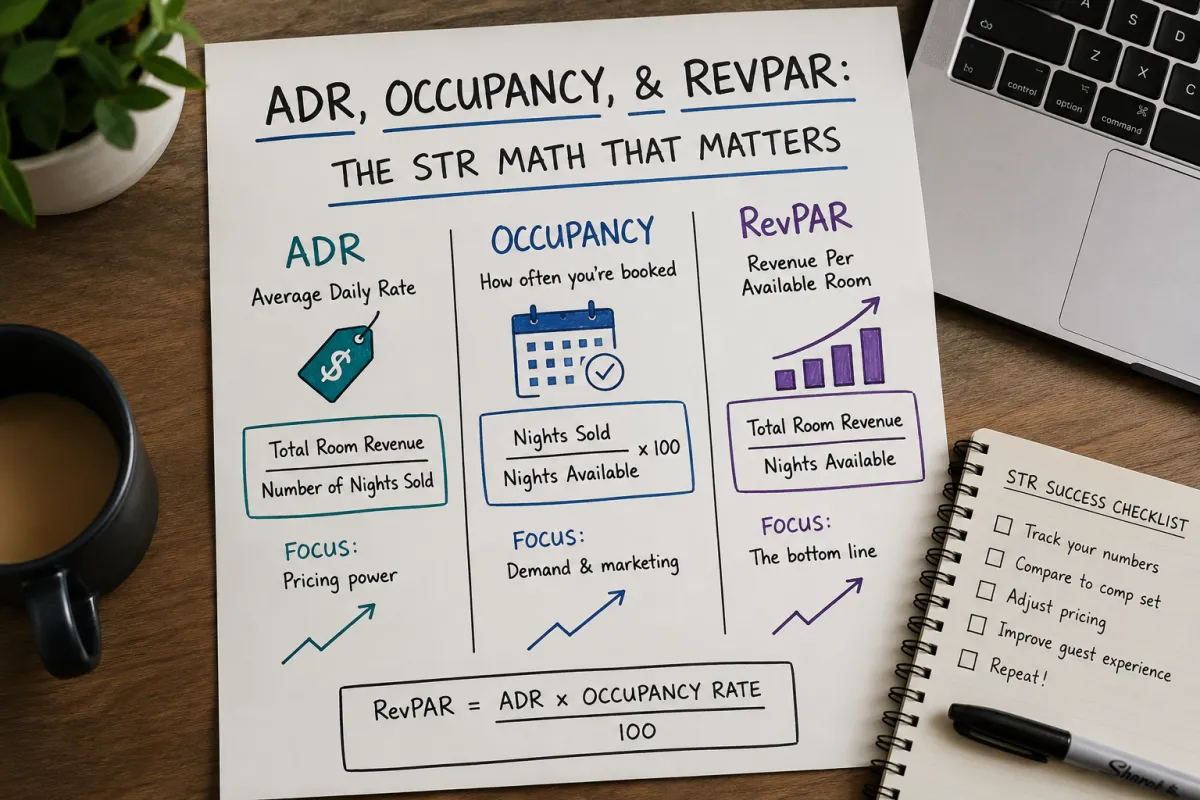
ADR, Occupancy, and RevPAR: The STR Math That Matters
Overview
STR profitability is governed by three metrics, and once you understand ADR, occupancy, and RevPAR, you can diagnose almost any property's performance without guessing. Average Daily Rate is what a booked night earns, occupancy is the share of available nights that book, and RevPAR, which is ADR multiplied by occupancy, is the truest measure of how a property is actually doing because it captures both pricing strength and calendar utilization in a single number. A listing can have a high ADR and still underperform if the calendar sits empty, and it can run near-full and still leave money on the table if the rate is too low. RevPAR is where those two forces meet, and it is the number owners should watch above all others.
Want to know your property's real RevPAR? Zenstays serves San Diego, Louisville, and Indianapolis. Get a free performance review at myzenstays.com.
The 3 Metrics That Define STR Performance
Average Daily Rate (ADR) defined
Average Daily Rate is the average price your property earns per booked night over a given period. You calculate it by dividing total booking revenue by the number of nights booked. ADR measures your pricing power, or how much a guest is willing to pay for a night in your property, but on its own it is incomplete. A property can post an impressive ADR simply because it is priced too high to book often, which is why ADR always has to be read next to occupancy rather than in isolation.
Occupancy rate defined
Occupancy rate is the percentage of your available nights that actually got booked. If 20 of 30 available nights booked in a month, occupancy is roughly 67 percent. It measures demand capture and how well your pricing, listing quality, and minimum-stay rules convert interest into confirmed nights. High occupancy at a low rate is not automatically good, because you may be filling the calendar by underpricing. Like ADR, occupancy only tells half the story on its own.
RevPAR defined and why it matters most
Revenue per Available Night, or RevPAR, is ADR multiplied by occupancy, and it is the single most reliable gauge of property performance. It answers the question that actually matters: across every night the property was available, how much did it earn on average? Because RevPAR blends pricing and utilization, it exposes the trade-off that ADR and occupancy hide individually. Raising your rate lifts ADR but can drop occupancy, and RevPAR tells you whether that trade was worth making. It is the number that cuts through the vanity metrics.
How to Calculate Each Metric Correctly
ADR with and without cleaning fees
How you treat cleaning fees changes your ADR, so consistency matters. A clean ADR reflects accommodation revenue only, excluding cleaning fees and other pass-through charges that are not really nightly income. Blending cleaning fees into ADR inflates the number and makes period-over-period comparisons meaningless. Decide on accommodation-only ADR and hold to it, because an honest rate is the one you can actually use to make pricing decisions.
Occupancy with available vs blocked nights
Occupancy is only accurate if your denominator is right. Nights you intentionally block, for owner use or maintenance, should be excluded from available nights, otherwise your occupancy looks artificially low. The metric should measure how well you converted the nights the property was truly on the market, not penalize you for nights you chose to hold back. Getting the available-night count right is the difference between a metric that guides decisions and one that misleads them.
RevPAR for monthly and annual reporting (CTA #2 after this H2)
RevPAR is most useful when tracked consistently across periods. Calculate it monthly to see seasonal shape and annually to benchmark the property against itself year over year and against comparable listings. Because it normalizes for both rate and occupancy, RevPAR lets you compare a peak month to a slow one, or one property to another, on equal footing. Monthly RevPAR reveals the pattern of the year, while annual RevPAR tells you whether the property is trending up or down.
Not sure your numbers are being tracked correctly? Zenstays reports RevPAR to every owner, every month. Reach out at myzenstays.com and we will get back to you fast.
How to Improve Each Metric
Pricing strategy levers for ADR
ADR improves through dynamic pricing that responds to demand rather than sitting on a flat rate all year. Raising rates around local events, high-demand weekends, and peak seasons lifts ADR where the market will bear it, while smart discounting fills the shoulder nights that would otherwise go empty. The goal is not the highest possible rate, it is the highest rate the calendar will still absorb, which is exactly the balance RevPAR is built to measure.
Listing quality and conversion for occupancy
Occupancy improves when more of the guests who see your listing decide to book it. Professional photography, a complete and specific listing description, strong review scores, and competitive positioning all lift conversion. So does removing friction, such as overly restrictive minimum stays that filter out otherwise willing guests. Occupancy is a conversion problem as much as a pricing one, and the listing itself is your primary conversion tool.
Minimum stay rules for RevPAR optimization
Minimum-stay rules are a lever that acts on RevPAR directly, because they shape both the rate you can hold and how completely the calendar fills. Too strict, and you leave bookable nights empty. Too loose, and you fill the calendar with one-night stays that drive up turnover cost and cleaning wear without improving revenue. Tuning minimum stays by season and demand window is one of the highest-leverage moves for lifting RevPAR without touching your base rate.
Frequently Asked Questions
What is a good RevPAR for an Airbnb property?
There is no universal number, because a strong RevPAR in one market can be weak in another. The right benchmark is comparable properties in your specific market and the same property's own trend over time. Rather than chasing a fixed target, compare your RevPAR against similar local listings and against your own prior periods, and focus on the direction it is moving.
Should I raise ADR or improve occupancy first?
It depends on which one is currently limiting your RevPAR. If your calendar is full but your rate is low, you likely have room to raise ADR without losing many nights. If your rate is healthy but the calendar sits empty, occupancy is the constraint and listing quality or pricing competitiveness is where to focus. RevPAR is the referee, because it tells you whether a change to either metric actually improved total performance.
How often should I recalculate these metrics?
Monthly is the practical cadence for most owners, with a fuller review each quarter and a year-over-year comparison annually. Monthly tracking catches seasonal shifts and pricing problems early enough to act on them, while quarterly and annual views reveal the longer trend. Checking too infrequently means you discover a soft stretch only after it has already cost you a season.
Do property managers report RevPAR to owners?
The better ones do, but many do not, which is a red flag. A manager who reports only revenue or only occupancy is showing you half the picture and making it harder to judge true performance. Transparent monthly reporting that includes ADR, occupancy, and RevPAR together is a sign your manager is accountable to the numbers that actually determine your return.
Your property's performance lives in three numbers. Zenstays tracks and reports all of them for owners in San Diego, Louisville, and Indianapolis. Get a free performance review at myzenstays.com.
