
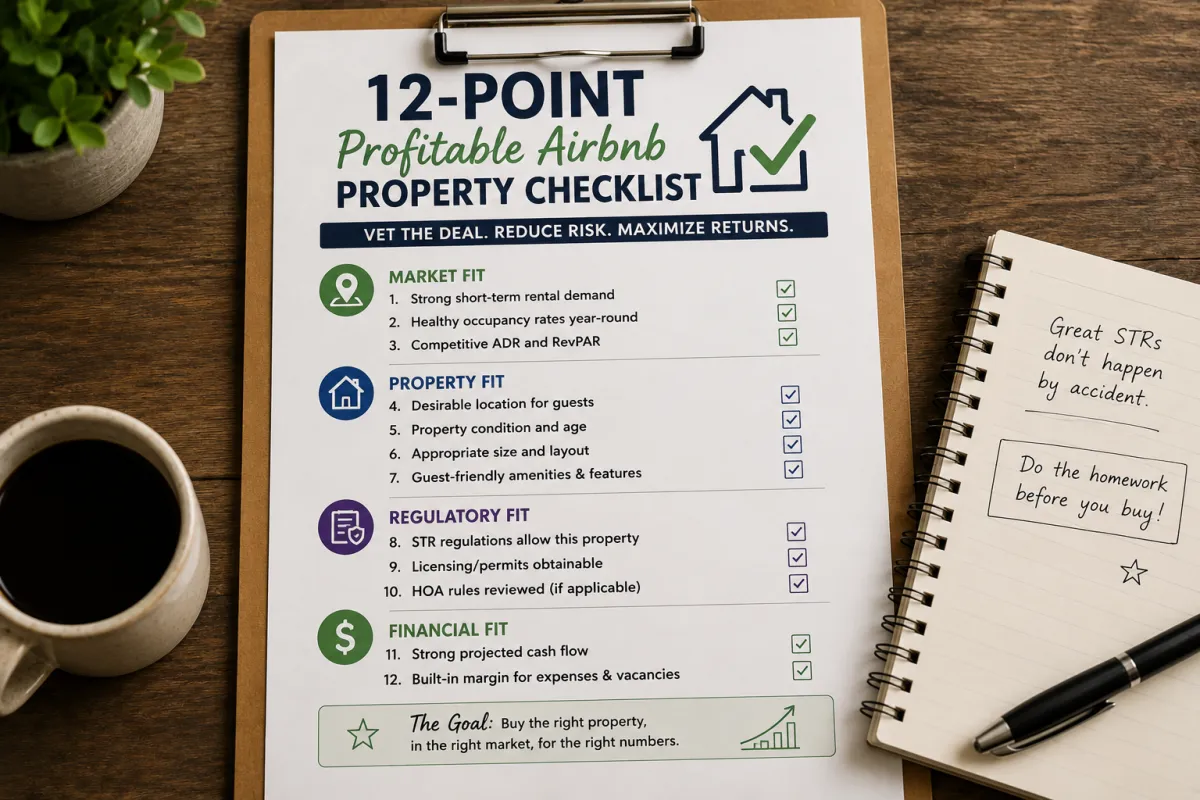
12-Point Profitable Airbnb Property Checklist
What Makes an Airbnb Property Profitable
Overview
A profitable Airbnb property satisfies twelve specific criteria across four categories, and running a prospective purchase through this checklist is the fastest way to separate a real income property from an expensive mistake. The four categories are market fit, which covers demand, seasonality, and comparable listings; property fit, which covers layout, amenities, and photo potential; regulatory fit, which covers zoning, permits, and HOA rules; and financial fit, which covers ADR, expense load, and return. Properties that fail more than three of the twelve checks are almost always unprofitable within eighteen months. The checklist is not about finding a perfect property, it is about knowing exactly where a property is weak before you commit capital to it.
Thinking about a purchase? Zenstays runs pre-purchase evaluations for investors in San Diego, Louisville, and Indianapolis. Get a free projection at myzenstays.com before you make an offer.
The 4 Categories Every STR Buyer Should Score
Market fit
Market fit asks whether the surrounding market can actually generate the demand your projection assumes. It covers the strength and consistency of local demand, how seasonal that demand is, and what comparable properties are truly booking. A beautiful property in a market with thin or collapsing demand will never perform, no matter how well you run it. Market fit is the first screen because it is the one factor you cannot fix after you buy.
Property fit
Property fit asks whether this specific property is built to win bookings in that market. Layout, sleeping capacity, standout amenities, and how the property will photograph all determine whether guests choose it over the listing next door. Two properties on the same block can perform very differently based on property fit alone, which is why it deserves its own scoring category rather than being lumped into the market view.
Regulatory fit
Regulatory fit asks whether you can legally operate the property as an STR, at the scale your projection assumes, for the foreseeable future. It covers zoning, permit eligibility, licensing caps, and HOA or condo rules. This is the category that most often kills a deal outright, because a property you cannot legally rent short-term is not an STR investment at all. Regulatory fit should be verified early, before you fall in love with the numbers.
Financial fit
Financial fit asks whether the money works after every real cost is counted. It covers achievable ADR, the full expense load, and whether projected RevPAR clears total cost with margin to spare. A property can pass market, property, and regulatory fit and still fail here if the purchase price is too high or the expense load too heavy. Financial fit is where the other three categories get translated into whether you actually make money.
The 12 Checks in Detail
Check 1: Market demand and ADR ceiling
Confirm the market generates enough consistent demand to support your occupancy assumption, and identify the realistic ADR ceiling that comparable properties are actually achieving. If the top comps cannot clear the rate your projection needs, the deal is built on a number the market will not pay.
Check 2: Year-over-year occupancy stability
Look at whether occupancy in the market has been stable, rising, or eroding over recent years. A market where occupancy is trending down as supply grows is a warning sign, even if current numbers still look acceptable.
Check 3: Competing supply within 1 mile
Count the comparable active listings near the property. Heavy nearby supply of similar properties pressures both your rate and your occupancy, because guests have more substitutes to choose from at the moment of booking.
Check 4: Bedroom count and ADR alignment (CTA #2 after this H2)
Make sure the property's bedroom count matches the ADR you are projecting. Guests pay for sleeping capacity, and a rate that assumes more bedrooms than the property has will not hold up once real bookings come in.
Want a second set of eyes on a property before you buy? Zenstays evaluates deals for investors across all three of our markets. Reach out at myzenstays.com and we will get back to you fast.
Check 5: Amenities that drive bookings
Identify whether the property has or can add the amenities that actually move the booking needle in its market, such as a hot tub, dedicated parking, a strong work setup, or outdoor space. Amenities are one of the few levers you control that directly lift both conversion and ADR.
Check 6: Listing photo potential
Assess how the property will photograph, because listing photos are the single biggest driver of click-through and booking on Airbnb. A property with great bones but poor light or awkward sightlines is harder to sell in a search grid, and that shows up in occupancy.
Check 7: Zoning and STR permit eligibility
Verify the property is zoned to allow short-term rental and that a permit is actually attainable. This is a pass or fail check, because a property that cannot be permitted cannot legally operate as an STR at all.
Check 8: HOA or condo association rules
Read the HOA or condo bylaws for any short-term rental restrictions or minimum-stay requirements. Associations can quietly prohibit or cap STR activity in ways a city permit does not reveal, and those rules can change after you buy.
Check 9: Local tax and licensing obligations
Account for occupancy taxes, transient room taxes, business licenses, and any annual registration the market requires. These obligations affect both your net return and your compliance workload, and ignoring them turns a profitable projection into an audit risk.
Check 10: All-in monthly expense load
Build the complete monthly expense picture, including mortgage, management, cleaning, supplies, utilities, insurance, taxes, and a maintenance reserve. The all-in number is what your revenue actually has to beat, and it is almost always higher than a first-pass estimate.
Check 11: Projected RevPAR vs total cost
Compare projected RevPAR against the total cost of holding and operating the property. This is the check that ties everything together, because it tells you whether the property clears its costs with the margin a healthy investment requires.
Check 12: Exit strategy and resale market
Confirm the property has a viable exit, whether as an STR sale, a long-term rental conversion, or a standard resale. A property you can only profit from as a short-term rental carries more risk than one that still works if the STR strategy has to change.
How to Score the Checklist Before Making an Offer
Pass/fail thresholds
Score each of the twelve checks as a clear pass or fail rather than a vague maybe. A property that passes market, regulatory, and financial fit with only minor property-level gaps is a strong candidate. Once a property fails more than three checks, or fails any single regulatory check, the risk profile changes enough that most investors should walk.
When a property is fixable vs structurally bad
Distinguish the weaknesses you can fix from the ones you cannot. Amenities, photos, and listing quality are fixable after purchase. Market demand, zoning, purchase price, and location are structural, and no amount of good management overcomes a structurally bad deal. The checklist is most valuable when it tells you which category a property's problems fall into.
Working a pre-purchase revenue projection through the checklist
The checklist and a pre-purchase revenue projection work best together. The projection quantifies the financial-fit checks with real ADR, occupancy, and expense numbers, while the checklist makes sure you have not ignored a regulatory or market factor the spreadsheet cannot see. Running both before you make an offer is how serious investors avoid the mistakes that only surface eighteen months in.
Frequently Asked Questions
How long does this 12-point evaluation take?
A focused investor can run the checklist on a single property in a few hours once they know where to find comp data, permit rules, and HOA bylaws. The financial-fit checks take the most time because they require a real expense schedule and a projection. The evaluation is far faster and cheaper than discovering a property's problems after closing.
Should I run this checklist on properties I already own?
Yes. Running it on a property you already own reveals which of the twelve factors are limiting its performance and which are fixable. Weaknesses in amenities, photos, or pricing can often be corrected, while structural issues in market or regulatory fit tell you whether it is worth holding, repositioning, or selling.
Can a property fail the checklist and still be profitable?
Occasionally, but it is the exception, not the rule. A property that fails a few property-fit checks can still profit if the market and financial fit are strong and the weaknesses are fixable. A property that fails regulatory or market fit almost never recovers, because those failures are structural and outside your control as an operator.
Where can I get a professional pre-purchase STR revenue projection?
Zenstays provides data-driven pre-purchase revenue projections for investors in San Diego, Louisville, and Indianapolis, built from real comparable properties, conservative occupancy assumptions, and a complete expense schedule. It pairs directly with this checklist so you can score both the numbers and the non-financial factors before you make an offer. You can request one at myzenstays.com.
Run the checklist, then check the numbers. Zenstays offers free pre-purchase STR revenue projections in San Diego, Louisville, and Indianapolis. Request yours at myzenstays.com.
